Rest • Joy • Recovery
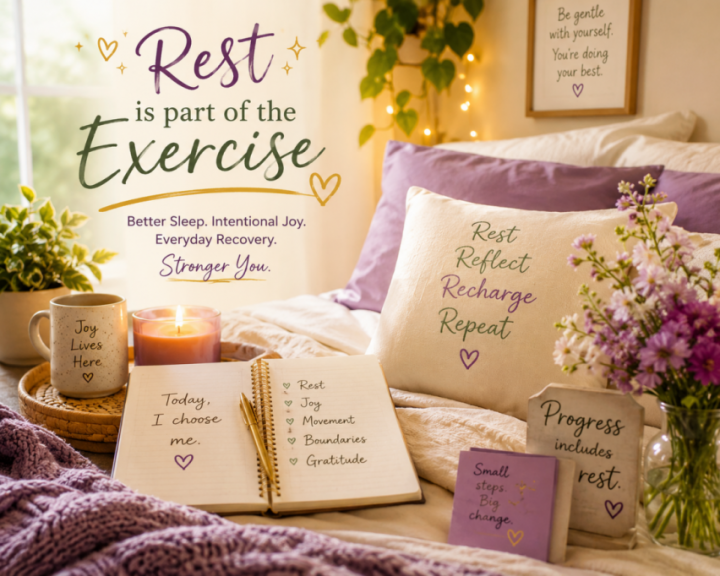
Rest Is Part of the Exercise
How to practice better sleep, create healthier moments of rest and make intentional joy part of everyday wellness.
I Have to Begin by Admitting Something to Myself
I don’t always get the best quality of sleep.
Some days are better than others. I can admit that too.
But I think admitting that there is room for improvement is actually a useful place to begin.
We often talk about wellness in terms of what we need to do. Eat better. Exercise. Drink enough water. Pay attention to our mental health. Develop healthier habits. Be mindful. Get outside. Keep moving.
Those things matter.
But what about learning how to stop?
What about sleep?
What about rest?
And what about something adults can sometimes forget to intentionally make room for—play, happiness and joy?
What If Rest Is Something We Practice?
When we hear the word exercise, we usually imagine movement. We might imagine walking, stretching, lifting weights, running or going to the gym.
But exercise can also mean practicing an ability.
For someone whose sleep routine is already wonderful, that practice may simply mean protecting what is already working.
For someone like me who knows there is room for improvement, it might mean becoming more intentional.
Maybe I need to go to bed an hour earlier. Maybe the computer needs to shut down. Maybe the movie can wait until tomorrow. Maybe phone notifications need to stop at a certain time.
Maybe I need to decide when the day is actually over instead of waiting until my body is completely exhausted before I finally stop.
Simply Admit There Is Room to Improve
Before changing anything, I think there is something powerful about being able to say:
That isn’t a punishment or criticism.
It is information.
When we recognize that something can improve, we can begin asking better questions.
What keeps me awake? What makes it difficult for me to transition from activity into rest? What am I doing during the last hour of my day?
What happens on the days when I sleep particularly well? What am I doing differently?
Am I bringing work into the hours when my mind needs to begin settling?
Do I actually have a bedtime, or do I simply go to sleep whenever everything else is finally finished?
Sleep Belongs Beside Diet and Exercise
We don’t have to make wellness complicated.
If we are improving our diet, that’s part of caring for the body. If we are exercising, that’s part of caring for the body.
If we are working on our mindset and emotional well-being, that is another part of caring for ourselves.
Sleep belongs in that conversation too.
Sleep supports important processes throughout the body and brain. During sleep, the body isn’t simply switched off. Sleep is involved in learning and memory, immune function, metabolism, emotional regulation and physical restoration.
Most adults generally need around seven or more hours of sleep regularly, although individual needs and circumstances differ. Children and teenagers generally require more sleep because development is still occurring.
But this article isn’t about turning bedtime into another stressful number we have to achieve perfectly.
How to Build a Rest Routine Without Turning Wellness Into Another Job
The goal isn’t perfection.
The goal is creating conditions that make rest more possible.
Start with something manageable.
Choose a time when you would ideally like to begin winding down. Then work backward.
Maybe thirty minutes before that time, you reduce unnecessary phone use.
Maybe you finish demanding computer work earlier.
Maybe the television goes off.
Maybe the lights become softer.
Maybe you read, stretch, shower, sit quietly, or write down tomorrow’s responsibilities so your mind doesn’t feel responsible for holding every unfinished task overnight.
Intentional Joy Is Different From Constant Entertainment
When I say we need more play, I don’t necessarily mean going to an amusement park or literally playing a game.
You certainly can.
But intentional play can be much simpler.
For one person, it might be reading. For another, painting. Someone might enjoy gardening.
Someone else might sit at a park.
You might cook something because you enjoy making it—not merely because dinner has to be prepared.
You could dance. Listen to music. Make something with your hands. Spend time with someone who makes you laugh. Walk somewhere beautiful. Write. Take photographs.
There Is Also a Time to Rest and a Time to Play
There is an old piece of wisdom that says there is a time for everything.
I think there is also a time to work, a time to learn, a time to solve problems—and a time to rest.
There is a time for intentional play.
Modern life can make that surprisingly difficult.
Work can follow us home. Entertainment never really ends. Social media never reaches its final page. News continues updating. Videos keep playing. Notifications keep arriving.
Artificial intelligence has added another powerful tool to that environment.
AI can help us create, learn, organize, research and work. But like every technology, it doesn’t have to occupy every available minute.
Technology Needs an Ending Time Too
Sometimes the problem isn’t technology itself.
The problem is that there is no clear stopping point.
One video becomes another. One email becomes five. One quick task becomes another hour of work.
Then suddenly the time that could have belonged to rest has disappeared.
Intentional Play Can Exist Inside an Ordinary Day
Joy doesn’t always require scheduling an entire day off.
Sometimes we can change the energy of something we’re already doing.
I do this with music.
There are times when I am working and begin feeling overwhelmed. I may still have work that needs to be completed, so simply abandoning everything isn’t necessarily the answer.
The responsibility hasn’t disappeared.
But my relationship with the moment changes.
There is a little more movement. A little more personality. A little more life in the room.
That matters because the way we approach our work can affect how we experience our work.
Joy Doesn’t Have to Be Earned
Sometimes we behave as though joy must come after everything else is finished.
After the work. After the cleaning. After the bills. After the emails. After everyone else’s needs.
Then we discover that “after” never arrives because there is always something else.
Rest, Movement, Nutrition and Joy Can Support One Another
Wellness doesn’t have to be separated into isolated boxes.
Movement can influence sleep. Sleep can influence how energetic we feel.
How rested we feel can affect the choices we make around food, movement and stress.
Our daily experiences and emotional state can affect how easy or difficult it feels to settle at night.
These relationships are complex, and no single habit guarantees perfect sleep.
That’s exactly why I prefer thinking about wellness as an ecosystem rather than a checklist.
Diet matters. Movement matters. Mental well-being matters. Relationships matter. Rest matters. Joy matters.
Try One Rest Intention and One Joy Intention
Don’t attempt to rebuild your entire lifestyle.
Choose one sleep intention and one joy intention.
Your sleep intention might be: I will begin winding down thirty minutes earlier.
Your joy intention might be: I will spend fifteen minutes doing something I enjoy without trying to make it productive.
At the end of seven days, keep what helped. Change what didn’t.
That is how a personal wellness practice becomes personal.
Rest Isn’t Wasted Time
Sometimes the most useful thing happening is recovery.
We don’t criticize a phone because it has to recharge. We understand why it needs energy.
Human beings are obviously far more complex than devices, but we sometimes give our technology more permission to recharge than we give ourselves.
Rest isn’t laziness.
Joy isn’t irresponsibility.
You Don’t Have to Become a Perfect Sleeper
I’m certainly not writing this from that position myself.
I’m writing it because I know my own sleep quality can improve.
And perhaps that awareness is enough to begin.
Maybe tonight I shut the computer down earlier.
Maybe tomorrow someone reading this takes a twenty-minute walk.
Someone else may pick up a paintbrush.
Someone might read three pages of a book.
Someone might call an old friend and laugh.
Someone may simply sit quietly for ten minutes and discover how much they needed the silence.
Sleep, Rest and Intentional Joy
1. What if I make time for sleep but still can’t sleep well?
Time in bed and sleep quality aren’t always the same thing. Start by looking at consistency, caffeine or alcohol timing, evening screen habits, stress, noise, temperature and how mentally activated you remain at bedtime. Persistent insomnia, loud snoring or gasping, significant daytime sleepiness or ongoing sleep difficulties should be discussed with a qualified healthcare professional.
2. Can having fun really improve my sleep?
Enjoyable activities can support well-being and may help some people manage stress, which can make winding down easier. Intentional play should not be treated as a guaranteed treatment for sleep problems, but it can be part of a broader environment that supports relaxation and healthier routines.
3. What if my idea of joy is simply being alone?
Then solitude may be part of your intentional joy. Play does not have to be social or energetic. Quiet reading, drawing, gardening, music, walking or peaceful time alone can all be restorative.
4. What if my work schedule prevents a traditional bedtime?
A traditional schedule is not possible for everyone. Shift workers, caregivers and people with irregular responsibilities can focus on creating as much consistency and protected sleep opportunity as their circumstances reasonably allow.
5. Should I use my phone to relax before sleeping?
It depends on what you are doing and how it affects you. Calming audio may feel very different from stressful messages or endless scrolling. If phone use repeatedly delays bedtime, create a cutoff period or try a non-screen wind-down activity.
6. How can families create intentional play without spending much money?
Create experiences instead of purchases. Try music, cooking together, neighborhood walks, drawing, storytelling, cards, libraries, outdoor time, gardening or a family technology-free hour.
7. How do I know whether I’m actually improving?
Look for patterns across several weeks instead of judging one night. Notice bedtime consistency, daytime energy, winding-down habits, technology use and whether enjoyable activities are becoming part of your routine.
Take the Reflection With You
Sometimes the next step is simply creating a little space to write, reflect and reconnect with yourself. I designed this digital journal as another way to continue that practice beyond this article.
Premier members can access this $9.99 digital journal at no additional cost as part of their member benefits.
Already a Premier member? Use the Premier access option above.
Enjoy More With Premier
Join NettaVibes Premier for access to included digital resources, member tools and selected downloads at no additional cost.
Explore Premier Membership