There comes a point when mindfulness has to move beyond………
The Media, the Mind, and Our Freedom
Reclaiming consciousness in the information age — and remembering that powerful communication should help people understand, participate, heal, grow, and think for themselves.
There comes a point when mindfulness has to move beyond what is happening inside of us and begin examining what is happening around us.
Mindfulness is not simply about being peaceful. It is also about being aware.
It is about discernment.
It is about developing the ability to receive information without automatically allowing that information to determine our emotions, our relationships, our understanding of our neighbors, or our understanding of the world.
Perhaps one of the most important places where this kind of discernment is needed today is within our relationship with the media.
I do not necessarily have to find a tape recorder, prepare a studio, or wait for someone else to give me a microphone before expressing an idea. Artificial intelligence and modern technology have advanced. I can pick up my phone, record my thoughts, organize those thoughts, and turn a spoken reflection into something that can be shared with other people.
That changes something important about communication.
The ability to communicate is becoming increasingly distributed.
A tragedy occurring in one neighborhood can influence how people thousands of miles away understand an entire city.
The First Amendment to the United States Constitution protects freedom of speech and freedom of the press, along with religion, peaceful assembly, and the right to petition government.
But freedom does not mean that every person, institution, corporation, commentator, journalist, or media organization will always communicate accurately, fairly, constructively, or responsibly.
That distinction matters.
Gives us room to communicate.
Helps us determine what deserves our trust.
Helps us decide what we do with information once we receive it.
Section One The Media Does Not Simply Report Reality — It Can Influence How Reality Is Perceived
The media has an extraordinary place within society because it is one of the places where millions of individual experiences become part of a collective conversation.
That means news is affecting real people.
When a station receives one hundred thousand views on a story about hardship, that can become one hundred thousand encounters with an image of hardship.
When communities repeatedly encounter stories of violence, political conflict, instability, fear, division, or failure, we should be willing to ask what happens when those messages become the overwhelming picture people receive of their communities.
This does not mean difficult information should disappear.
We need journalism that investigates problems.
We need people willing to ask uncomfortable questions.
We need reporting about failures, injustice, corruption, disasters, elections, conflicts, institutions, economics, education, public safety, and the problems affecting ordinary people.
Reporting that a problem exists is one responsibility.
Helping people understand the problem is another.
Showing where credible solutions are being attempted can be another.
Explaining what succeeded, what failed, what is still unknown, and what ordinary people can actually do with the information can transform news from something we merely consume into something we understand.
We already know that problems exist.
People live those problems.
Communities experience those problems.
Families sometimes carry those problems home.
So what else can communication give us?
- Can it help us understand?
- Can it help us learn?
- Can it help communities discover resources?
- Can it introduce possibilities?
- Can it show people what is improving?
- Can it investigate solutions with the same seriousness that it investigates failures?
People are biological beings.
We are not robotic beings designed to absorb unlimited conflict.
Biological beings want to grow.
People want to evolve.
People want to continue experiencing life, understanding life, and finding a better or greater mindset from which to approach it.
Not by hiding reality.
Not by forcing positivity.
Not by telling citizens what political conclusions they must reach.
But by giving people enough truthful, contextual, and useful information to think for themselves.
That is where mindfulness enters journalism.
And it is also where mindfulness enters the audience.
Before accepting a headline as the entire story, ask:
- What actually happened?
- What evidence supports this?
- What information might still be missing?
- Is this reporting, analysis, opinion, or commentary?
- Are different positions being described accurately?
- Is the headline more emotionally dramatic than the information underneath it?
- Can I find the original document?
- Can I hear the complete statement rather than only a short clip?
- Can I compare another credible source?
These questions do not weaken freedom of speech.
Section Two Free Speech and a Free Press Also Require an Engaged Public
Freedom of the press is enormously important.
So is freedom of speech.
But neither concept means that citizens surrender their own judgment to whoever owns the largest microphone.
The media represents part of our national conversation.
It does not represent the entire whole of our capacity to speak, think, learn, question, or understand one another.
A free society still needs readers.
Listeners.
Researchers.
Writers.
Teachers.
Parents.
Scientists.
Community leaders.
Independent journalists.
Local reporters.
Young people asking questions.
Older people carrying institutional memory.
People willing to change their minds when evidence changes.
And people willing to disagree without believing that disagreement requires permanent conflict.
This is why I believe the conversation has to move beyond simply asking:
We also need to start asking:
- Would it provide sources?
- Would it separate reporting from opinion?
- Would it correct mistakes openly?
- Would it explain uncertainty?
- Would it investigate problems while also examining credible attempts to solve them?
- Would local journalism show communities what resources and opportunities exist?
- Would economic reporting help ordinary people understand changing conditions?
- Would journalists return after a crisis and tell us what happened next?
- Would meaningful progress receive attention even when it is less dramatic than conflict?
People should not have to choose between bad news and ignorance.
There is also something important about accountability.
Freedom of the press should protect journalism’s ability to investigate powerful institutions.
At the same time, a free public should remain capable of questioning journalism.
Those ideas can exist together.
Supporting the freedom of journalists does not require agreeing with every journalist.
Protecting speech does not require believing every speaker.
Disagreeing with news coverage does not require silencing the press.
Respecting journalism does not require giving away our own discernment.
Section Three A Nation Cannot Solve Every Problem Through Permanent Conflict
There is something else I believe media organizations should understand.
People get tired of never-ending fights.
We have differences.
We will continue to have differences.
Political parties will disagree.
Communities will disagree.
Generations will disagree.
Religions will disagree.
Researchers will disagree.
Families will disagree.
Journalists themselves will disagree.
What if we asked different questions?
- Can we disagree and still identify what keeps us connected?
- Can political disagreement exist without neighbors becoming enemies?
- Can journalism examine differences without converting every difference into hostility?
- Can citizens explain what they value instead of building their identities entirely around what they oppose?
These questions matter beyond any single election.
Elections are not the only moments when citizenship exists.
Communities continue to exist between elections.
Children continue learning between elections.
Businesses continue operating.
Families continue making decisions.
Cities continue trying to solve problems.
People continue falling in love, grieving, studying, creating, worshipping, healing, inventing, and imagining their futures.
Our elections should ultimately belong to an informed public capable of considering competing information and making its own decisions.
Journalism can investigate.
Question.
Explain.
Compare factual claims.
Examine records.
Identify contradictions.
Bring information into the open.
And then people can decide what they believe and how they want to participate.
Imagine more reporting that asks:
- How can we resolve conflicts?
- How can communities cooperate despite differences?
- What programs are working?
- What opportunities are available?
- What did we learn from something that failed?
- Where are people finding solutions?
- Who is rebuilding?
- Who is teaching?
- Who is creating?
- Who is mentoring?
- Who is healing?
- Who is opening doors for another generation?
- What can another community learn from them?
None of this means ignoring wrongdoing.
It means understanding that exposing what is broken and studying what might repair it can coexist.
Section Four Memphis, Community Voice, and Reclaiming Discernment
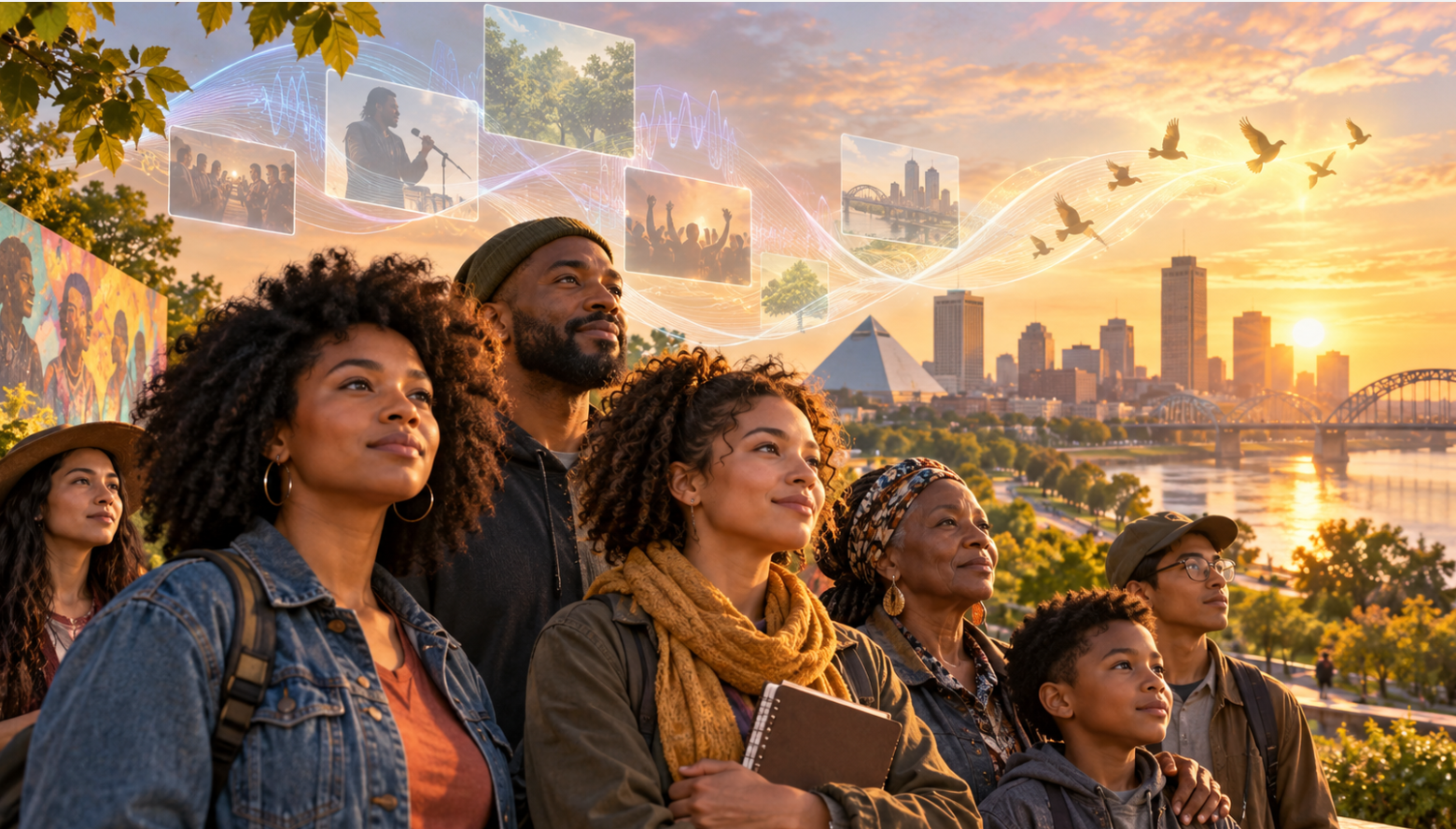
And this conversation becomes even more personal when I bring it home to Memphis, Tennessee.
Memphis matters.
It matters to the people who live here.
It matters to Tennessee.
It matters within the history and culture of this country.
And it matters when we talk about how communities see themselves reflected through media.
Memphis is a majority-Black city.
That reality is worth acknowledging because Black communities are not separate from the American story.
Our experiences matter.
Our opportunities matter.
Our businesses matter.
Our children matter.
Our healing matters.
Our growth matters.
Our voices matter.
Our participation matters.
And the images continually presented about our communities matter too.
Memphis needs to see great things happening throughout the nation.
Memphis needs to see that its voices matter.
Memphis needs to see growing opportunities.
It needs to see healing.
It needs to see growth.
It needs to see community.
It needs to see unity.
It needs to see accomplishment.
It needs to see people solving problems.
It needs to see possibilities.
Tennessee should be able to look across this nation and see examples of communities evolving, people rebuilding, families progressing, young people creating, businesses growing, neighborhoods transforming, and people finding new ways to work together.
The Country Is Larger Than Its Conflicts
We do not always need another story about who dislikes the president.
We do not always need another story about who dislikes a member of Congress.
We do not always need another story about political personalities fighting with one another.
Those stories may sometimes be legitimate news.
But they are not the entirety of America.
America also consists of people waking up every morning and trying again.
Neighborhoods.
Schools.
Churches.
Community organizations.
Families.
Small businesses.
Artists.
Writers.
Workers.
Entrepreneurs.
Researchers.
Caregivers.
Teachers.
Children imagining who they will become.
People are trying to build better lives.
People are recovering.
People are forgiving.
People are inventing.
People are believing.
And people may disagree on politics while still wanting safe neighborhoods, opportunities for their children, meaningful work, strong families, and a future worth looking forward to.
The Media Is Not Merely Talking to Memphis — It Is Reflecting Memphis
When media organizations are on the news, they are not simply talking to us.
They are helping reflect a country back to us.
That carries enormous influence.
When people outside of Memphis continually receive one kind of image of Memphis, that image can begin shaping their understanding of a city they may never have visited.
The same thing happens to other cities.
The same thing happens to rural communities.
The same thing happens to different racial communities.
The same thing happens to different regions.
That means representation deserves thoughtfulness.
We can report hardship without reducing communities to hardship.
We can report crime without suggesting that crime represents every person living in a city.
We can report political disagreement without suggesting that disagreement is the only thing Americans share.
We can acknowledge racial differences while recognizing shared humanity.
We can talk about Black communities not only when something has gone wrong, but when people are building, creating, succeeding, learning, organizing, healing, and contributing.
That is balance.
And balance does not mean pretending every story is positive.
Balance means refusing to mistake one part of reality for the entire reality.
Press Encouragement Into Communities
If media organizations want to assess what encouragement can do across a nation, then let us see encouragement pressed into communities.
Press empowerment into communities.
Press healing into communities.
Press humanity into communities.
Encourage people to feel like people.
Let someone in Memphis see another community creating something remarkable and think:
Let someone in another city see something happening in Memphis and think:
Let a young person watch the news and discover somebody building the type of future they never realized was possible.
Let someone struggling financially discover a legitimate opportunity.
Let communities learn how another community reduced a problem.
Let people discover organizations doing work they can support.
Let journalism become a bridge through which useful knowledge travels.
That is information serving people.
Reclaiming Our Own Discernment
The transformation cannot occur only inside media organizations.
It also has to occur within us.
We have to become conscious consumers of information.
We cannot assume that because something has been repeated frequently it automatically becomes true.
We cannot assume that because information makes us angry it must therefore be accurate.
And we cannot assume that information we agree with deserves less scrutiny than information we oppose.
Mindfulness gives us the ability to create a small space between information and reaction.
Inside that space, we regain choice.
- We can read before sharing.
- We can check another source.
- We can examine evidence.
- We can distinguish facts from predictions.
- We can recognize commentary rather than reporting.
- We can notice when language appears designed primarily to provoke.
- We can ask what is known.
- We can acknowledge what remains uncertain.
- We can turn the news off when our minds need rest.
- And we can return later with greater clarity.
There is nothing irresponsible about protecting your consciousness.
Doing so may allow you to participate in your community with greater awareness.
The Future of News Should Help People Think — Not Think for Them
Ultimately, the media should never become the owner of our consciousness.
Its greatest contribution is not deciding what millions of people must believe.
Its greatest contribution can be helping people become better informed so they are capable of deciding for themselves.
With informed people.
With thoughtful communities.
With citizens willing to ask questions.
With journalists willing to investigate them.
With people willing to listen.
With communities willing to learn.
And with a society mature enough to understand that freedom of speech is not simply the freedom to make noise.
To question.
To challenge.
To listen.
To reconsider.
To communicate.
To learn from one another.
And sometimes, to discover a better next step.
The media has enormous influence over our collective view of things.
That influence reaches beyond today’s population.
The stories being published now also become part of what future generations inherit about this period.
That means there is an opportunity here.
Media organizations can ask themselves what they want their contribution to be.
Communities can ask what information they want to support.
Citizens can ask what kind of information deserves their attention.
Local voices can speak for themselves.
And each of us can become more mindful about what we allow to enter our minds and what we choose to pass forward.
We already know our problems exist.
We should absolutely continue investigating them.
But humanity also needs to know where it is growing.
Where it is learning.
Where people are resolving differences.
Where communities are improving.
Where opportunities are being created.
Where people are getting something right.
Where Memphis is succeeding.
Where Tennessee is progressing.
Where another city discovered an answer that might help ours.
Where our community discovered something that might help another.
And where the next better step might be.
It can deepen its value.
Because the future of a free press should not merely be about reaching the greatest number of people. It should also be about giving people information worthy of their freedom.
The ability to see ourselves not only through our struggles, but through our possibilities.