How to Balance Your Nervous System and Release Generational Trauma
By Netta Reads: A Practical Ancestral Guide for Transforming Inherited Pain into Inherited Peace
There are easier ways to do things for the greater good. There are also easier ways to redirect our lives toward the peace we were always worthy of inheriting.
We do not have to make healing harder on ourselves for it to be real. We do not have to understand every scientific term, follow one religion, belong to one culture, or have a perfect family. We can begin in simple, human ways, one choice, one breath, and one peaceful moment at a time.
This is a practical guide to balancing the nervous system and beginning to release generational trauma. It is also about an ancestral shift: using consciousness and awareness to recognize deep,rooted family cycles of inherited pain and begin transforming them into inherited peace.
Anybody can begin this work. It does not matter who you are, what you believe, where you come from, or what kind of trauma has lived within your family story. Anybody can reclaim peace. Any family can begin breaking a cycle of inherited pain.
Sometimes it requires only one person in a family to say:
This pain will not continue through me in the same way.
Imagine what can happen when two people make that decision. Imagine three people, then a family, a community, a nation, and eventually a planet. Imagine what inherited peace can do when it becomes visible enough to guide other people toward the same possibility.
What an Ancestral Shift Really Means
An ancestral shift does not simply mean becoming more spiritually conscious. It also means learning more about who you are, what shaped you, what your body has learned, and what you want to carry forward.
Breaking a cycle does not mean blaming your parents, grandparents, or ancestors for everything they did not know how to heal. It does not mean denying what happened or pretending pain was acceptable. It means becoming conscious of what has been repeated and deciding that what reaches the next generation can be gentler, safer, wiser, and more loving.
You can honor what your ancestors survived without repeating every survival behavior they developed. You can say:
This response may have protected someone in my family once, but I am allowed to choose what protects me now.
An ancestral shift can happen when you:
- Speak honestly instead of continuing a family pattern of silence.
- Set a boundary where fear or control was mistaken for love.
- Rest when your family taught you that rest was laziness.
- Ask for help when previous generations had to hide their pain.
- Let children be children instead of making them carry adult responsibilities.
- Learn to disagree without humiliating, threatening, or abandoning one another.
- Refuse to pass forward the harm that was handed to you.
One person cannot repair an entire family alone, and no survivor is responsible for saving everyone. Yet one person can change what they personally carry, practice, accept, and pass forward.
That individual shift matters. It is how inherited pain begins losing some of its authority and inherited peace begins becoming real.
The Nervous System: A Bridge Between Body, Mind, and Experience
The nervous system is connected to the physical body, and it participates in everything we experience. It responds to words, heartbreak, repeated family patterns, joy, pain, gratitude, love, fear, safety, sound, touch, memory, and the environment around us.
Even when a person falls in love, the nervous system participates in that experience. The heartbeat may change. The body may feel warm. The breath may become lighter. Closeness may begin to feel safe.
The nervous system is one of the significant inner compasses that helps us understand what is happening in the body. We sometimes talk about the mind as though it works alone. In reality, the brain, body, emotions, senses, and nervous system continually communicate with one another.
The nervous system does not literally store peace like a physical object. It does not hold billions of separate emotions, and it does not travel at the speed of light. Those expressions can still work as spiritual or poetic ways of describing how fast and powerful our reactions may feel.
Scientifically, the body can respond to possible danger or safety before we have found the words to explain what we feel.
A sound, smell, facial expression, tone of voice, or familiar situation may activate a response before conscious thought catches up. A person may understand mentally that the present moment is safe and still experience tight shoulders, a clenched jaw, a racing heart, rapid breathing, numbness, restlessness, difficulty concentrating, or an urge to fight, run, freeze, please, or hide.
The body is not necessarily betraying that person. It may be using an old protection pattern that once made sense. Fear is part of the body’s protective response, and people can continue feeling stressed even after traumatic danger has passed, according to the National Institute of Mental Health.
Trauma can shape how the nervous system responds. Family environments can pass forward learned beliefs, coping styles, relationship patterns, and expectations of danger. Biology and social conditions may play a role too.
But generational trauma is not a permanent sentence written into the body.
Healing is not about commanding the nervous system to forget. It is about helping the body experience enough present,day safety that every reminder does not have to feel like the original danger is happening again.
We can remember and still become freer.
Peace Does Not Require Perfection
One of the most important parts of this guidance is understanding that you do not have to become perfect to obtain peace.
You do not need a perfect mind, a perfect nervous system, or a perfect family. You do not have to be peaceful every moment. You do not have to eliminate frustration, doubt, anger, sadness, or fear before peace becomes available.
Even people who study the brain, counsel others, practice medicine, teach spirituality, or help people improve their mental health can experience stress, depression, anxiety, doubt, or exhaustion.
Knowledge does not remove someone from the biological experience of being human.
A counselor may still need counseling. A teacher can still learn. A healer can still receive help. A strong person can still need rest.
While we are helping, we may also be helped. While teaching, we may also learn. While healing, we may help someone else heal. That is the value of being hands,on with life.
Human growth is not a straight line. There will be moments of gratitude and alignment. There may also be moments of frustration, confusion, grief, doubt, and fear. None of those experiences automatically means healing has failed.
A balanced nervous system is not one that never becomes activated. It is one that can move through activation and return toward steadiness with support.
Peace is not emotional silence. It is the growing ability to remain connected to yourself while emotion moves through you.
Every Emotion Can Be Guided Toward Peace
The nervous system may participate in a wide range of emotions: love, joy, gratitude, determination, compassion, frustration, doubt, anger, sadness, and unconditional love.
These emotions do not all feel the same, and science does not establish that each has a single spiritual “frequency.” Still, frequency can be used as a personal metaphor for the different intensity or quality of an emotional experience.
Every emotion can be met with guidance.
- Love may need honesty and boundaries before it becomes peaceful.
- Compassion may need wisdom so that it does not become self,abandonment.
- Kindness may need safety so that it does not become people,pleasing.
- Anger may need a healthy direction so that it protects a boundary without becoming harm.
- Doubt may need time and reliable information.
- Frustration may need rest, movement, expression, or a different plan.
It is not always enough to tell yourself to be kind or compassionate. Ask what would help that kindness or compassion reach a peaceful form.
- What emotion am I experiencing? Name it without judging it.
- Where do I notice it in my body? Notice pressure, heat, tightness, heaviness, movement, or numbness.
- What might it be communicating? It may point to a need, boundary, loss, danger, hope, or desire.
- What would keep me and others safe? Safety comes before proving a point.
- What peaceful response can I choose? Pause, speak, leave, rest, ask for help, write, breathe, or return later.
This is one way to turn emotion into guidance instead of allowing it to become automatic behavior.
How to Turn Judgment into Guidance
It is human to judge. Judgment can arise quickly because the mind is continually trying to sort, compare, predict, and protect. But judgment does not have to become the final response.
There is a real way to turn judgment into guidance, spiritually, mentally, physically, and practically.
If your first thought is, “I should be over this by now,” guidance may answer:
Something in me still needs understanding, safety, or support.
If you think, “My family is broken,” guidance may answer:
My family has painful patterns, and I can decide which patterns I will no longer practice.
If you think, “I am weak because I became triggered,” guidance may answer:
My body responded to something it associated with danger. I can help it return to the present.
If you think, “They are a bad person,” guidance may ask:
What behavior caused harm? What boundary is needed? What evidence would demonstrate genuine change?
Guidance does not mean ignoring accountability. It does not mean accepting abuse, restoring unsafe relationships, or excusing harmful behavior.
Guidance makes judgment more useful by asking what the situation is teaching, what protection is needed, and what action supports peace.
Use this shift:
- Notice the judgment.
- Identify the fear or value beneath it.
- Separate what happened from what you assume it means.
- Look for a boundary, lesson, request, repair, or next step.
- Choose an action that does not create more inherited pain.
The universe may be understood spiritually as more than a cosmic housing place, as a source of guidance, relationship, and inherited possibility.
A person does not have to share that belief to use this practice. Someone may call the source God, the universe, higher consciousness, wisdom, nature, community, human dignity, or simply the values they choose to live by.
The language can change while the guidance remains available.
Find What Brings You Peace Right Now
Now we return to one of the easiest and most important questions:
What brings you a sense of peace in this right,now moment?
Maybe it is prayer. Maybe it is hearing your own voice and speaking kindly to yourself. Maybe it is looking through a window at an open sky or watching a tree move in the wind.
Maybe it is drinking coffee slowly, sitting alone without explaining yourself, talking with a trusted friend, going to a park, meditating, singing, humming, dancing, stretching, gardening, creating, or walking.
Peace does not have to arrive as a dramatic breakthrough.
It may first appear as ten seconds in which your jaw softens, your shoulders lower, or your exhale becomes longer.
When you notice a peaceful moment, pause long enough for your body to register it:
I am here. My feet are on the floor. I can see the room around me. I have a choice. I am safe enough in this moment to take one slow breath.
Relaxation practices can encourage a physical relaxation response that may include slower breathing and reductions in heart rate and blood pressure, according to the National Center for Complementary and Integrative Health.
That does not mean one breathing exercise will resolve trauma. It means simple practices can be useful parts of a larger support plan.
Seven Easy Ways to Practice Inherited Peace
1. Orient Yourself to the Present
Slowly look around. Name where you are, the date, and what you can see.
Remind yourself that a memory, trigger, or fear is not always the same as present danger.
2. Let the Exhale Become Slightly Longer
Do not force a deep breath if it makes you uncomfortable.
Breathe in gently, then allow a slightly longer, softer exhale. Repeat only if it feels supportive.
3. Use Your Senses
Name five things you see, four things you feel, three things you hear, two things you smell, and one thing you taste.
This can redirect your attention toward the present environment.
4. Add Safe Movement or Sound
Stretch, walk, sway, dance, sing, or hum.
Movement can give activated energy a safe direction. Sound may help some people feel present and connected.
5. Create One Peaceful Boundary
Say:
I cannot discuss this while I am being yelled at.
Or:
I need time before I answer.
Or:
I am not available for that.
A boundary is not punishment. It explains what you will do to protect safety and dignity.
6. Record Evidence of Peace
Write down the small moments:
- I paused before responding.
- I rested without apologizing.
- I asked for help.
- I told the truth without cruelty.
- I stepped outside.
- I did not repeat the harmful thing that was done to me.
7. Return Instead of Demanding Perfection
If you become activated again, return to the practice.
Returning is not failure.
Returning is the practice.
Not every method works for every person. Closing the eyes may calm one person and feel unsafe to another. Silence may be peaceful for one person and activating for someone else.
The goal is not to perform healing correctly. The goal is to discover what your body recognizes as supportive.
Identify the Family Cycle You Want to Change
Ask yourself gently:
- What repeatedly happened when someone expressed sadness, anger, fear, joy, need, or disagreement?
- Were feelings welcomed, mocked, punished, ignored, or turned into conflict?
- Did people have to remain quiet to feel safe?
- Was rest treated as laziness?
- Was love offered only when someone obeyed, succeeded, rescued others, or kept secrets?
- Did the family confuse control with protection, silence with peace, or endurance with strength?
These questions are not meant to create a courtroom inside your mind. They make invisible patterns visible.
Once a pattern is visible, you can practice a different response.
Write one new family statement:
- In this life, love does not require fear.
- We are allowed to rest.
- Children do not carry adult responsibilities.
- We tell the truth without humiliating one another.
- We can seek help without shame.
- An apology must be followed by changed behavior.
- We can disagree and still protect one another’s dignity.
Neuroplasticity refers to the nervous system’s capacity to change its activity and reorganize aspects of its structure, function, or connections in response to experience.
This does not promise instant healing, but it supports a grounded idea: repetition, learning, and new experiences can matter. The nervous system is capable of change.
Peace Can Be Used Again and Again
Peace does not require a perfect family or perfect circumstances.
Even during difficult situations, moments of peace can be created, remembered, practiced, and returned to.
We can use peace of mind at school. We can use it at home, work, church, family reunions, and while sitting alone. We can carry the practice into unfamiliar places because peace is not limited to one building, title, culture, or belief.
Spiritually, you may understand this as inherited peace that never runs out.
Scientifically, it may be more accurate to say that repeated experiences and regulation practices can help the mind and body become more familiar with certain responses.
Both forms of language can live beside each other when we are clear about which is spiritual meaning and which is scientific evidence.
You are not expected to feel calm every moment.
You are learning that pain is not the only state available to you.
When Support Should Become Part of the Guide
Prayer, friendship, church, family meetings, meditation, medical care, and therapy do not have to compete. Each may serve a different purpose.
Persistent panic, flashbacks, dissociation, severe depression, thoughts of self,harm, or symptoms that interfere with daily life deserve professional support.
The National Institute of Mental Health recommends seeking professional help when trauma symptoms do not improve or begin interfering with daily life.
Seeking help is not a failure to inherit peace.
It is one way of protecting it.
The Ancestral Shift You Can Begin Today
You do not have to heal everything today.
You do not have to forgive anyone before you are ready.
You do not have to restore an unsafe relationship or force yourself to feel grateful for trauma.
You are allowed to grieve what happened and still create something different.
You are allowed to protect your peace with boundaries.
You are allowed to feel joy without believing it betrays those who suffered before you.
Sometimes one person begins the cycle of inherited peace.
Imagine two people.
Imagine three people.
Imagine a family, a community, a nation, and a planet learning that strength can include softness, awareness can interrupt reaction, and healing can happen without denying history.
Your nervous system does not need perfection from you. It needs truthful, repeatable experiences that say:
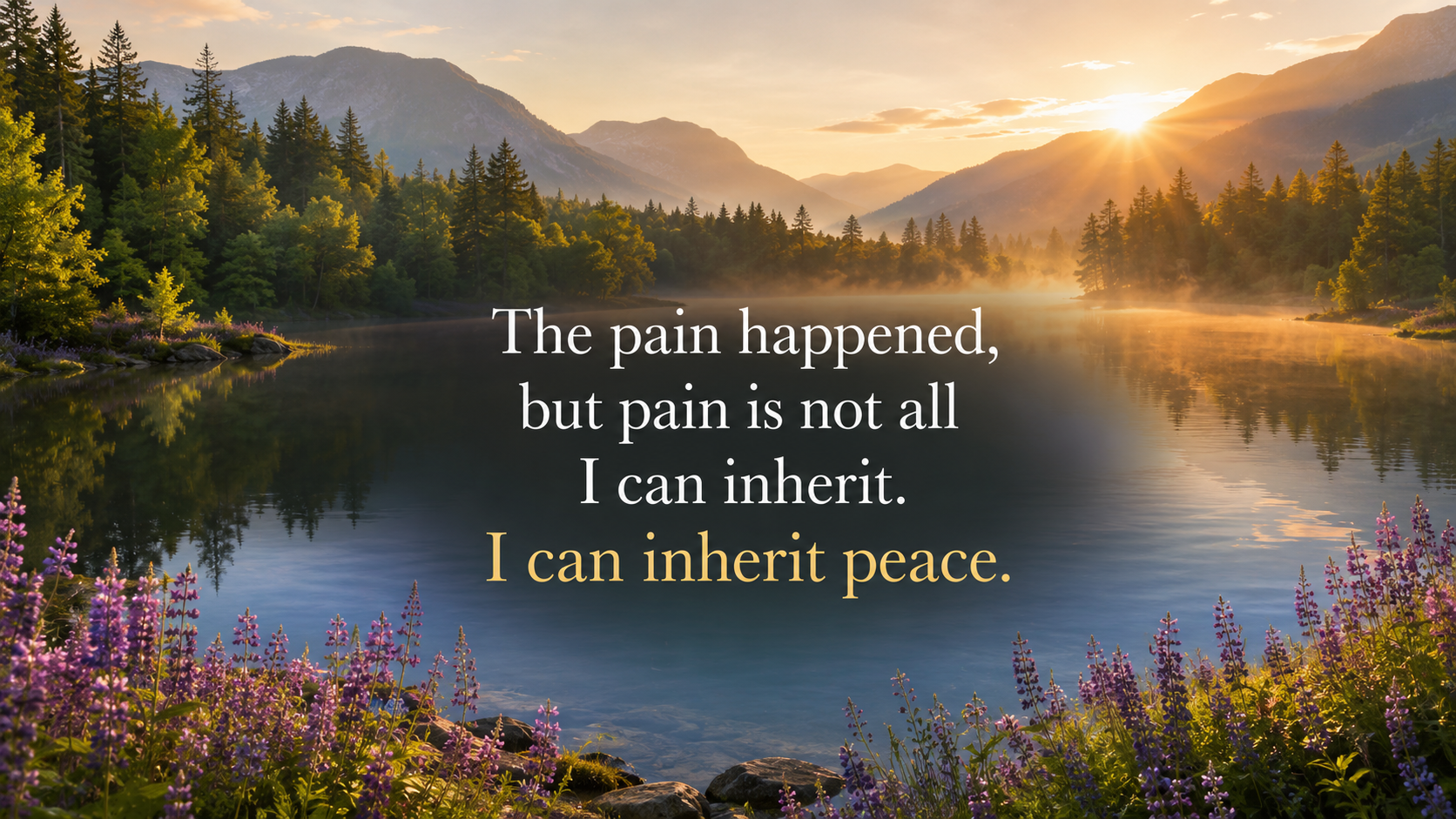
- The pain happened, but pain is not all I can inherit.
- I can inherit wisdom.
- I can inherit choice.
- I can inherit compassion.
- I can inherit rest.
- I can inherit a voice.
- I can inherit safety.
- I can inherit peace.
That is the ancestral shift.
It is not pretending that the past never existed.
It is refusing to let inherited pain write the entire future.