NettaVibes | Personal Growth & Emotional Wellness
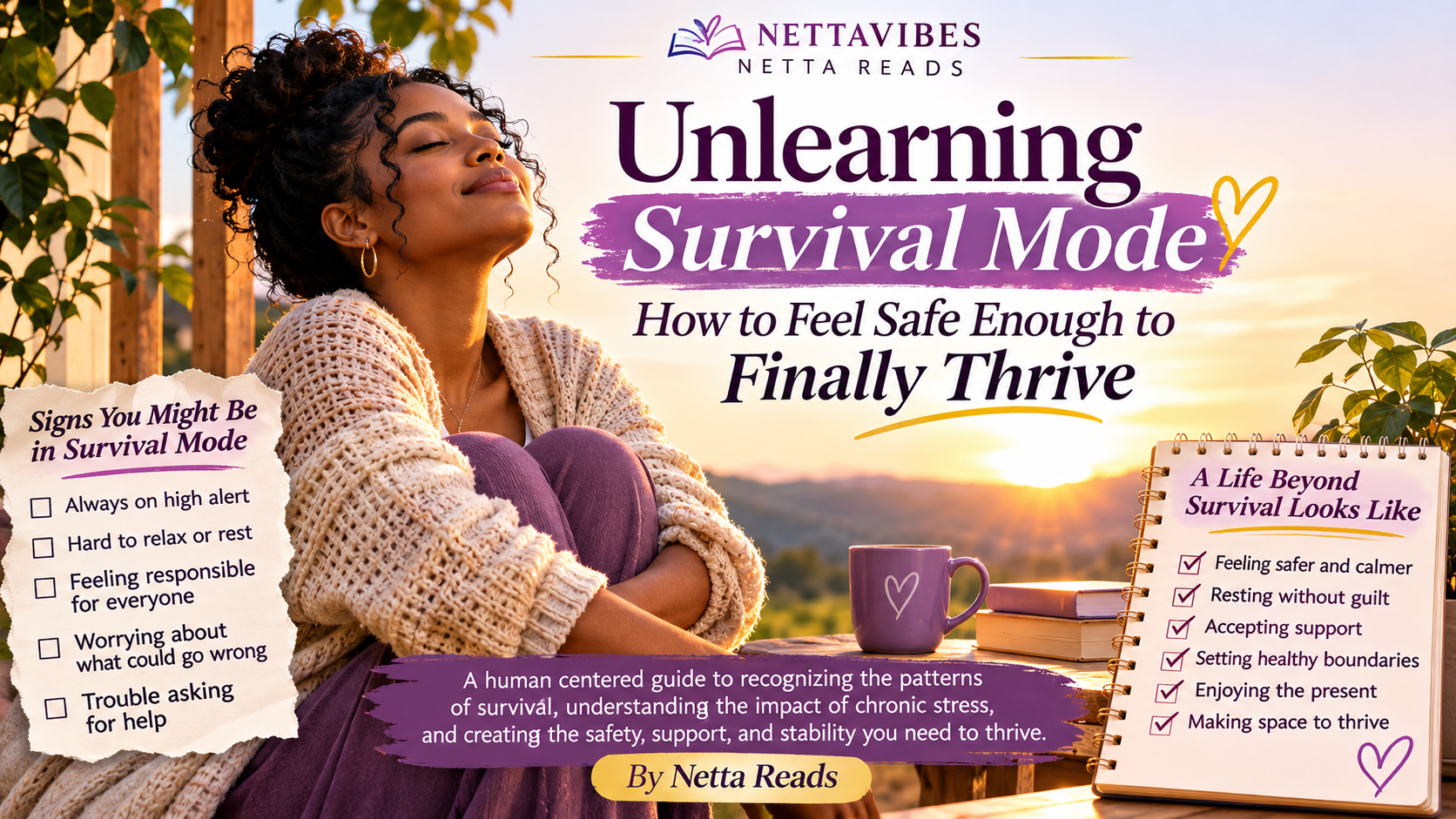
Unlearning Survival Mode: How to Feel Safe Enough to Finally Thrive
An honest, human centered exploration of why surviving can become a way of life, how prolonged stress affects us, and what it means to begin living beyond constant worry, responsibility, and emotional exhaustion.
What happens when you’ve spent so much of your life being strong that you no longer know how to feel at ease?
Imagine finally having a quiet afternoon. There are no immediate demands, no urgent phone calls, and nothing particularly troubling happening around you. Yet somehow, you still cannot relax.
You begin thinking about tomorrow’s responsibilities. You wonder whether you’ve forgotten something important. Perhaps you feel guilty for sitting down when there is still so much you could accomplish.
And before you realize it, a peaceful moment has become another opportunity to worry.
For many people, this experience is surprisingly familiar.
We become so accustomed to handling difficult situations, anticipating problems, and carrying responsibilities that simply enjoying the present can begin to feel unfamiliar.
Sometimes the hardest part of surviving isn’t getting through the difficult season. It’s learning how to live when every moment no longer needs to be treated like an emergency.
But there is something important to understand: survival is not a personal failure. It is a human capacity. Our ability to adapt, respond to danger, and protect ourselves is part of what allows us to navigate life’s challenges.
The question is what happens when the same protective responses remain active long after a particular threat has passed, or when life’s pressures rarely give us enough opportunity to recover.
This is where the journey toward thriving begins.
1. Understanding Survival Mode: When Protection Becomes a Daily Pattern
The phrase survival mode is commonly used to describe the experience of living under ongoing pressure, uncertainty, or perceived threat. It is not a formal medical diagnosis, but it captures something meaningful about everyday human experience.
Survival mode can show up in ways we don’t always recognize.
You might be someone who:
- Feels responsible for solving everyone else’s problems, even when you’re exhausted.
- Finds it difficult to rest without feeling unproductive.
- Constantly prepares for what might go wrong, even when things are going reasonably well.
- Struggles to ask for help because you’ve become accustomed to doing everything independently.
- Feels uncomfortable receiving kindness, assistance, or an opportunity without expecting something difficult to follow.
These experiences do not automatically mean someone has experienced trauma or has a mental health condition. They can arise from numerous circumstances, including financial uncertainty, demanding work, caregiving responsibilities, difficult relationships, grief, or prolonged instability.
Consider a parent who spends years stretching every dollar, making sure the children have what they need, and figuring out how to handle one unexpected bill after another.
Even when the family’s financial circumstances improve, that parent may continue checking every expense or anticipating the next emergency.
Or consider someone who has worked in an unpredictable environment for years. Even after moving into a healthier workplace, they may still feel uneasy when a supervisor asks to speak with them.
These responses can make sense in the context of what someone has experienced.
A habit that once helped you feel prepared may eventually begin limiting your ability to experience peace.
Recognizing that possibility is not about criticizing the way you learned to cope. It is about becoming more aware of whether those same habits are still serving your present circumstances.
2. What Science Tells Us About Chronic Stress
Our bodies are equipped with systems that help us respond to challenges.
When the brain detects a threat or demanding situation, stress response systems can activate, changing processes such as heart rate, attention, and the release of stress hormones.
These responses are useful when we need to react quickly.
However, the effects can become more complicated when stress is frequent, prolonged, or difficult to escape.
One scientific framework for understanding this is called allostasis.
Allostasis describes how the body maintains stability by adjusting to changing demands. When these adjustments happen repeatedly over time, they can contribute to what researchers call allostatic load, the cumulative physiological burden associated with ongoing adaptation to stress.
Research associated with neuroscientist Bruce McEwen helped establish this framework, which has been used to investigate relationships between stress, the brain, and physical health.
In everyday language, consider a car engine.
An engine is designed to accelerate when needed, but it also needs appropriate maintenance and periods of lower demand. Keeping it under intense strain continuously can create wear over time.
Human biology is much more complex than an engine, but the comparison helps explain why recovery matters.
Long term stress can be associated with difficulties involving sleep, concentration, mood, physical discomfort, and overall health. The effects vary considerably between individuals.
Another important idea comes from the transactional model of stress and coping, which examines how people evaluate stressful situations, the resources they believe they have, and the coping strategies they use.
For example, two people might receive the same unexpected bill.
One has savings, supportive family members, and confidence that the bill can be handled. The other is already behind on expenses and has no dependable assistance.
The situation is similar, but the available resources and perceived level of threat are different.
Emotional well being is not simply determined by how positively we think. It is also shaped by the conditions we live in, the resources available to us, and the support we can realistically access.
Understanding stress through this broader perspective allows us to approach recovery with compassion rather than unrealistic expectations.
3. When Being Strong Becomes Emotionally Exhausting
There is a particular kind of exhaustion that comes from always being the dependable person.
You’re the one everyone calls when something goes wrong.
You’re the one who keeps the household organized, manages unexpected problems, offers encouragement, and finds a way to keep moving forward.
And because you have handled so much before, people may assume that you will always be able to handle more.
Eventually, you may begin believing that yourself.
But being capable of carrying a heavy responsibility does not mean carrying it indefinitely is healthy.
Sometimes we confuse endurance with emotional well being.
We say:
“I’ve been through worse.”
“Other people have bigger problems.”
“I’ll rest when everything is taken care of.”
These thoughts may help us continue during difficult circumstances. But when they become our only way of responding to life, we may overlook our own needs.
One of the most meaningful changes we can make is to stop treating exhaustion as proof of dedication.
You can be responsible without being available every moment.
You can be compassionate without accepting every burden.
And you can be a strong person who also needs reassurance, practical help, friendship, and time to recover.
Strength should create room for your humanity, not require you to ignore it.
4. Why Peace Can Feel Unfamiliar
Have you ever noticed that when life finally becomes a little quieter, your thoughts seem to get louder?
Perhaps you start imagining problems that haven’t happened.
Maybe you question whether a positive opportunity is too good to be true.
Or you find yourself returning to old situations mentally, even though you would rather move forward.
For some people, this reflects the understandable habit of remaining alert after long periods of uncertainty.
After distressing experiences, people may become particularly attentive to possible warning signs. In trauma related situations, this can sometimes involve hypervigilance, or heightened watchfulness for danger.
But it is important not to assume that every difficulty relaxing is a trauma response. Sleep problems, health conditions, anxiety, demanding schedules, and ongoing practical concerns can also contribute.
What matters is learning to distinguish between the conditions surrounding us and the expectations we may have developed.
Is something threatening my safety right now, or am I anticipating a difficulty because of what I’ve experienced before?
Sometimes the answer will be that the current situation is reasonably safe.
Other times, there may be a genuine problem that needs attention.
Both answers deserve respect.
If someone is facing housing insecurity, an unsafe relationship, or serious financial hardship, telling them to simply relax would overlook the conditions contributing to their stress.
Feeling safer often requires practical changes, reliable support, and greater stability, not just calming thoughts.
And when our circumstances do become safer, it may take time to recognize and trust that change.
5. Unlearning Survival Mode Doesn’t Mean Forgetting What You’ve Survived
We often speak about healing as if it requires becoming an entirely different person.
But perhaps the goal is not to erase our past or abandon the qualities that helped us through it.
Perhaps it is to develop greater freedom in how we respond to the present.
You can remember a difficult financial season without automatically assuming every future expense will become a crisis.
You can recognize the lessons of a painful relationship without assuming everyone you meet will hurt you.
You can appreciate how resourceful you became during difficult years while also learning that you deserve experiences beyond constant responsibility.
This is an important distinction.
Unlearning survival mode does not require abandoning awareness, sensible caution, or personal boundaries.
It means gradually recognizing when protective habits are helpful and when they are unnecessarily limiting your choices.
The goal is not to become someone who never worries. The goal is to become someone who has more than worry available as a response to life.
6. How to Begin Feeling Safe Enough to Thrive
Thriving is often described through major accomplishments: financial success, professional recognition, personal transformation, or reaching an extraordinary goal.
But for someone who has lived through extended uncertainty, thriving may begin with much simpler experiences.
It might mean sleeping without mentally rehearsing tomorrow’s problems.
Having an enjoyable conversation without checking the time.
Accepting help without feeling ashamed.
Making an ordinary mistake without turning it into a judgment about your entire life.
Or having an afternoon when you feel present enough to enjoy what is happening.
These moments are not insignificant. They are part of what makes life feel worth living.
Start by creating small experiences of predictability
You do not have to completely reorganize your life to introduce a little more stability.
Perhaps you choose one evening routine that allows you to prepare for tomorrow without spending the entire night worrying.
Maybe you designate a reasonable time to review your finances instead of checking them repeatedly throughout the day.
Or you begin identifying which tasks are genuinely urgent and which can wait.
A predictable routine cannot eliminate every stressor, but it may reduce the number of decisions competing for your attention.
Give your body opportunities to recover
Walking, stretching, getting appropriate sleep, spending time outdoors, and practicing comfortable breathing or relaxation exercises can all support stress management.
Choose approaches that feel manageable rather than forcing yourself through an elaborate wellness routine.
A person who is working two jobs, caring for relatives, or navigating limited resources may not have an hour available for meditation.
Five quiet minutes may be more realistic.
For some people, sitting still can actually increase distress. Gentle movement or an absorbing activity may feel more comfortable.
The point is not to perform relaxation perfectly. It is to find forms of recovery that fit your circumstances.
Recognize the importance of safe relationships
Human beings need connection.
Supportive relationships can provide emotional reassurance, practical assistance, and a sense of belonging during stressful periods.
But connection should not come at the expense of personal safety.
You do not have to maintain access to someone simply because they have been part of your life for years.
Sometimes moving toward greater well being means improving communication, establishing boundaries, asking for assistance, or spending less time in relationships that repeatedly create distress.
Replace constant self pressure with realistic expectations
Instead of asking, “How much more can I accomplish today?”
Consider asking, “What genuinely needs my attention today, and what can reasonably wait?”
This is not an excuse to abandon responsibility.
It is a way of understanding that your energy, attention, and time are valuable resources.
You do not have to exhaust every resource to prove that you are making progress.
7. A Different Way to Measure Personal Growth
One of the most overlooked aspects of growth is that progress does not always look impressive from the outside.
Sometimes it looks like declining an invitation when you need rest.
Sometimes it means having an uncomfortable but necessary conversation.
Sometimes it means responding thoughtfully rather than reacting immediately.
And sometimes it means admitting that a situation requires more support than you can provide yourself.
Personal growth is not always about becoming more productive.
It can also involve becoming more aware, more adaptable, and more intentional about how you use your energy.
We can think about this through three connected experiences:
Surviving is finding ways to get through what is immediately in front of us.
Recovering is creating opportunities to regain energy, stability, and perspective.
Thriving is having enough support, opportunity, and personal freedom to participate in life beyond simply responding to its demands.
These are not fixed stages that everyone moves through in order. A person may thrive in one area while facing serious difficulties in another.
You might enjoy meaningful friendships while working through financial instability.
You might be professionally successful while learning to establish healthier boundaries.
Human experience is rarely as simple as moving from one condition to another and never looking back.
Thriving is not the permanent absence of hardship.
It is the growing ability to live meaningfully while meeting life’s changing realities.
8. A Gentle Exercise: What Does Safety Mean to Me Today?
Set aside a few minutes for a personal reflection. You can write your answers in a journal or simply think them through.
Question One: What am I still carrying that may no longer belong to my present circumstances?
This could be an expectation, a responsibility, a fear, or a habit that developed during an especially difficult period.
Question Two: What would help me feel more supported in my everyday life?
Think beyond positive thinking. Consider practical resources, healthier routines, dependable people, clearer boundaries, or professional assistance.
Question Three: What is one small experience I would like to enjoy without rushing through it?
Perhaps it is sitting outside with your morning coffee, reading for pleasure, creating something, enjoying a peaceful meal, or taking time to explore a personal interest.
Choose one realistic action.
There is no need to turn this exercise into another demanding assignment.
The purpose is to reconnect with your own needs and preferences.
9. You Are Allowed to Want More Than a Life You Can Endure
There may come a moment when you begin to recognize just how much energy you’ve spent preparing for problems, protecting others, and making sure everything continues to function.
And you may begin asking a different question.
Not simply, “How will I get through this?”
But:
What kind of life am I working so hard to make possible?
That question can change the direction of your attention.
It invites you to think about what you enjoy, what you value, and what you would like to experience, not only what you need to prevent.
You may want stronger relationships.
You may want time for learning, creativity, laughter, or peaceful reflection.
You may want financial stability, a healthier home environment, or the freedom to make decisions without overwhelming fear.
These are meaningful human needs and aspirations.
And wanting them does not diminish the courage it took to survive what came before.
Final Reflection: There Is More to Life Than Being Prepared for the Worst
We do not always get to choose the difficulties that shape our lives.
We do not always have immediate control over the financial, social, family, or personal circumstances that create uncertainty.
But wherever possible, we can begin creating conditions that give us greater opportunities for stability, connection, rest, and personal fulfillment.
Some changes will be small. Others may require time, outside support, or significant adjustments to our circumstances.
And progress may not follow a straight line.
There will still be challenging days.
There may still be moments when familiar worries return.
That does not mean the effort to grow has failed.
It means we are human beings continually adapting to the lives we are living.
Perhaps unlearning survival mode is not about teaching ourselves never to be afraid.
Perhaps it is about learning that fear does not have to make every decision, responsibility does not have to consume every moment, and strength does not have to come at the expense of peace.
You have learned how to make it through difficult days. You also deserve the opportunity to experience days that are genuinely good.
And sometimes, the beginning of thriving is simply recognizing that both possibilities belong in your life.
A Thought to Carry With You
I can appreciate the strength that helped me survive while making room for the peace, support, and opportunities that help me grow.
Reflection question: When was the last time you allowed yourself to enjoy a peaceful moment without feeling that you needed to earn it?
Research and Further Reading
The psychological concepts and health information discussed in this article are informed by these sources:
- American Psychological Association: Healthy Ways to Handle Life’s Stressors
- National Institutes of Health: Emotional Wellness Toolkit
- Bruce McEwen: Neurobiological and Systemic Effects of Chronic Stress
- American Psychological Association: Transactional Model of Stress and Coping
- National Institute of Mental Health: Caring for Your Mental Health
Educational note: This article is intended for personal reflection and general education. It is not a diagnosis or a substitute for medical or mental health care. If persistent stress is significantly interfering with your health or daily life, a qualified health professional can help you evaluate possible causes and available support.
Kind words, real voices
Reviewed and approved by this community's moderators.
No published reviews yet. Your story could be the first.